
Qimbo is a ton of fun. It’s a breath of fresh air in the stale world of you-must-stand-still disc games. Unlike ultimate, disc golf, Kan Jam, Guts, DDC, Bottle-Bash, and all the others, you CAN run with the disc in Qimbo!
The game is still in development. We’ve been playing and testing and play-testing many different rules and new equipment. The following are the current rules we use, but we are constantly trying new ones to make the game even more fun. A couple of those are included at the end. Follow along to get updates on the rules as they develop on our side.
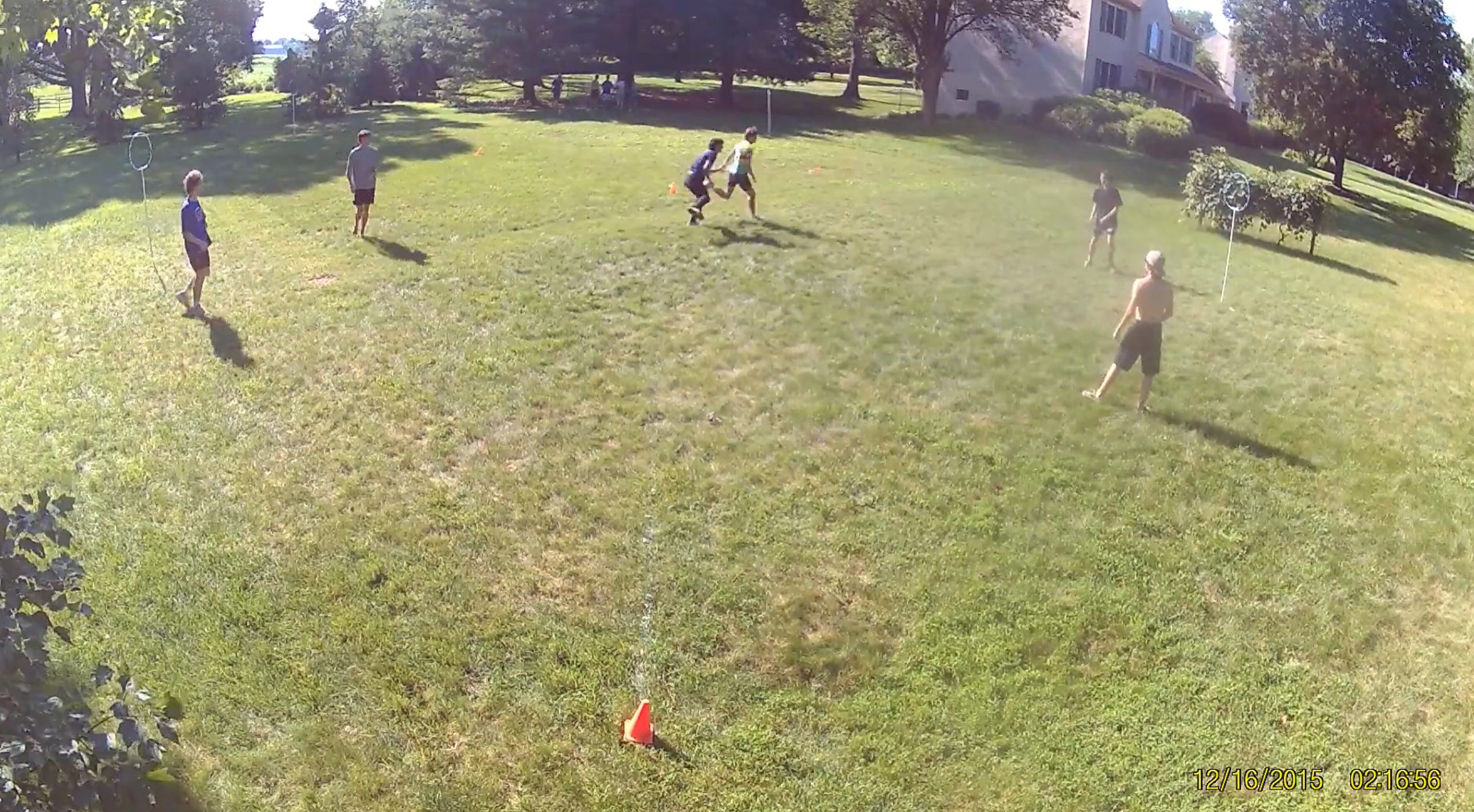
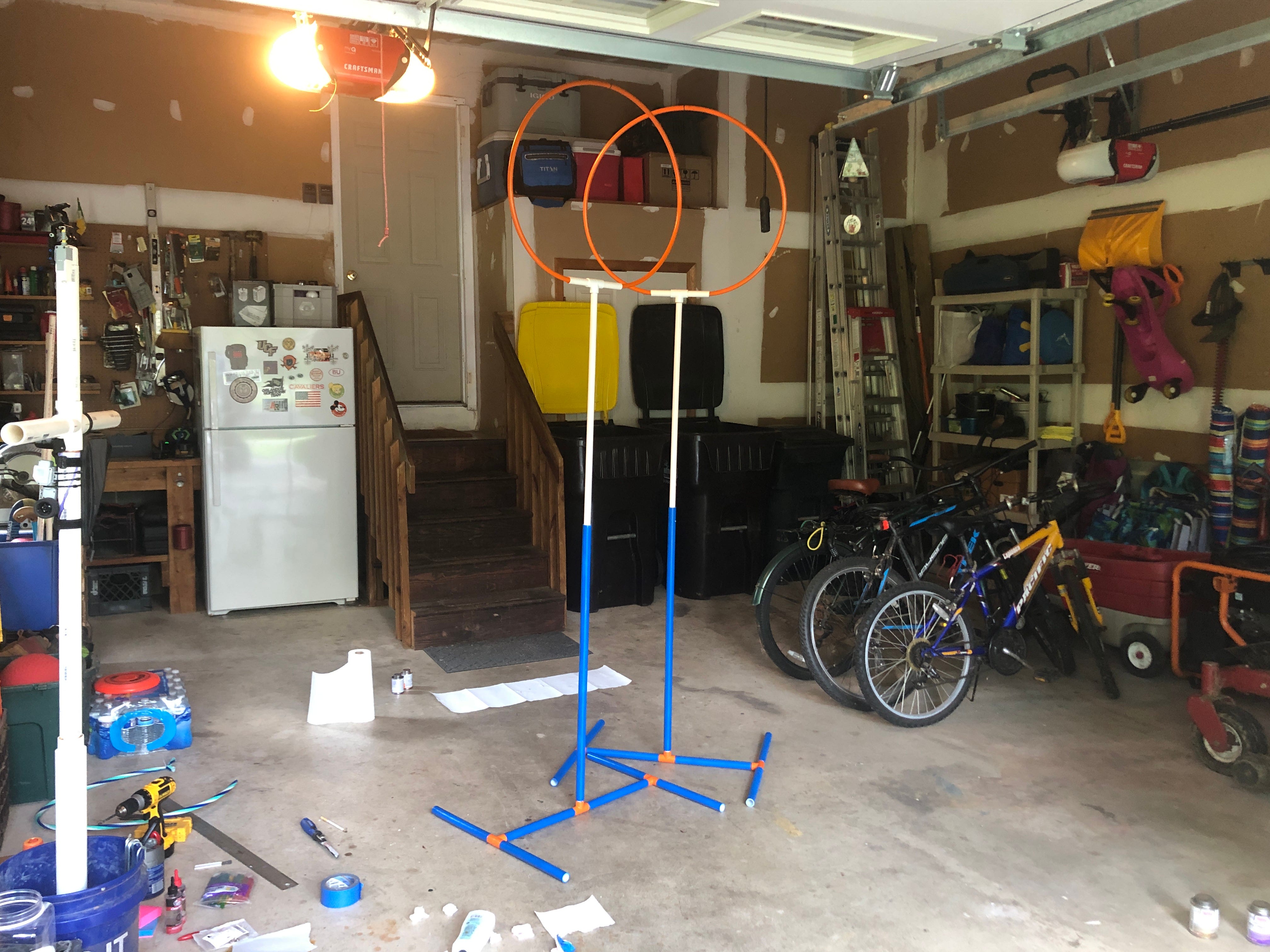
As you can (kinda) see, Qimbo is played with a small disc and hoops. The disc is a Wham-O Pro Model 15 Frisbee. The hoops are (currently) custom made. Our goal is to make these hoops super-portable and durable so Qimbo can be played anywhere, anytime, by anyone. Subscribe to follow along as we improve our prototype, start the first small batch, and eventually take it to a manufacturer!
If you’re interested in playing, but don’t have access to any hoops or discs, don’t worry! While it may not be perfect, you can play something similar to Qimbo with any random disc and some milk crates (or buckets or trash cans etc.). Instead of shooting the disc through a hoop, it just has to hit a crate. Ultimate frisbee discs are okay to use but smaller discs like fastbacks are much much better.
Goal:
Score points by throwing the disc through either of the two hoops. +2 if shot through backside of the hoop.
Movement:
The disc can be moved around the field in any direction by passing it to a teammate or by “running” with it.
Possession:
After catching the disc, you must quickly come to a stop and set a pivot-foot or start your “run”.
If you choose to stop, a defender will count 5 seconds out loud, during which, you can either throw the disc or start your “run”. At 5 seconds, your “run” automatically begins.
“Run”:
After you begin your “run” by moving your pivot-foot, you are free to move (walk, jog, run) anywhere on the field. You may still shoot, throw, or pass the disc in any direction you choose. However, if a player on defense tags you before you release the disc, it is a turnover and you must drop the disc where you were tagged.
Gameplay:
Any incomplete pass, missed shot, interception, dropped disc, or tagged runner results in a turnover.
After turnovers or a successful point scored, the disc must be reset before another shot can be taken at either of the hoops.
Resetting the Disc:
In order to reset the disc, it must travel between the halfcourt cones. It can travel via a successful pass between teammates or a “run”.
Clarification:
For a pass to travel “through” the reset cones, the line drawn from thrower to reciever must pass through the cones; The flight path of the disc does not matter. For a “run” to pass “through” the cones, the runner must make contact with the ground on the other side of the reset line.
Hoops:
Putting your hand through the hoops or hitting the disc back through the hoop to stop a score us not allowed. Doing so results in a point for the offense.
Self-Pass:
Passing to yourself is allowed. However, because your pivot foot will almost always have moved after doing so, self-passes commonly result in the start of (or continuation of) your “run”. You can therefore be tagged for a turnover once you catch the disc again.
Tipping, brushing, or maccing the disc does not count as catching it. You cannot be tagged for a turnover until you catch the disc.
Matches, Fields, & Players:
The standard hoops are 20 yards apart, with half-court at the 10. The reset cones are 10 yards apart. Games are to 11, win by 2 (3v3).
Freedom to Play:
This game MUST be maximized for fun. If for any reason players are not having fun, or think they could be having more fun, they have the right to change any of the rules to this game so long as both teams agree. Experimenting with the rules is required.
Further Gameplay:
After a successful shot, the defense gains possession and is now offense.
Players who don’t have the disc are free to move anywhere on the field. Picks are allowed. Moving screens are not.
RULE VARIATIONS:
2v2 is played on a small court. The hoops are 10 yards apart. Reset line remains 10 yards wide, however. Self-passes are not allowed in 2v2 (unless you want them to be).
1v1 is possible, but we’re still workshopping the rules a bit. Basically, self-passes are allowed (and necessary) but your possession resets after each catch (ie. you can’t be tagged for a turnover then). Also, you are only allowed to throw & catch with one hand. It’s played on the 2v2 sized field. This involves more freestyling techniques than the others. It’s pretty damn fun.
Possession after scoring: Current rules are that the defense becomes offense after a point is scored. We’ve experimented with the offense being able to maintain possession after scoring if they can catch the disc after it goes through the hoop. Importantly, you have to throw the disc through the hoop to score, so while you could self-pass through the hoop here to maintain possession (though this would start your “run”), you cannot just hand-it-off to yourself through the hoop. Having a teammate catch your score is much harder. We’ve made that an extra point in the past. We’ve also experimented with the rule that, if the defense catches your shot after it passes through the hoop, the score is negated. **We have not played these variations much; They’ll need more testing to see if it’s balanced / fun.**
Scoring by Reset-Runs: Tested once in 3v3, this rule allows teams to score an extra point per possession if they can successfully have all teammates cross the reset line via a “run”. This works to pull the defense away from the hoops, making shots on the hoops more varied than just dunks and defenses more creative than 1-1-1.
Stationary Catching: Another rule we’ve experimented with is disallowing “slow-down steps” after a catch. If you can’t come to a full stop immediately after catching the disc, your “run” begins and you can be tagged for a turnover. This is (essentially) how it works in basketball and would remove boring/unsafe sprints into the hoop defenders for a score. In watching game footage, it is also apparent that most catches are stationary anyways, unless someone was intentionally starting their “run”. This one’s pretty exciting; We’ll keep ya’ll updated on how it goes.
SAND: Like all sports, it’s harder to move on sand. So far, we’ve found that a larger field makes it easier on the legs and more fun. We’ll need to playtest this more in the future.